August 24, 2026
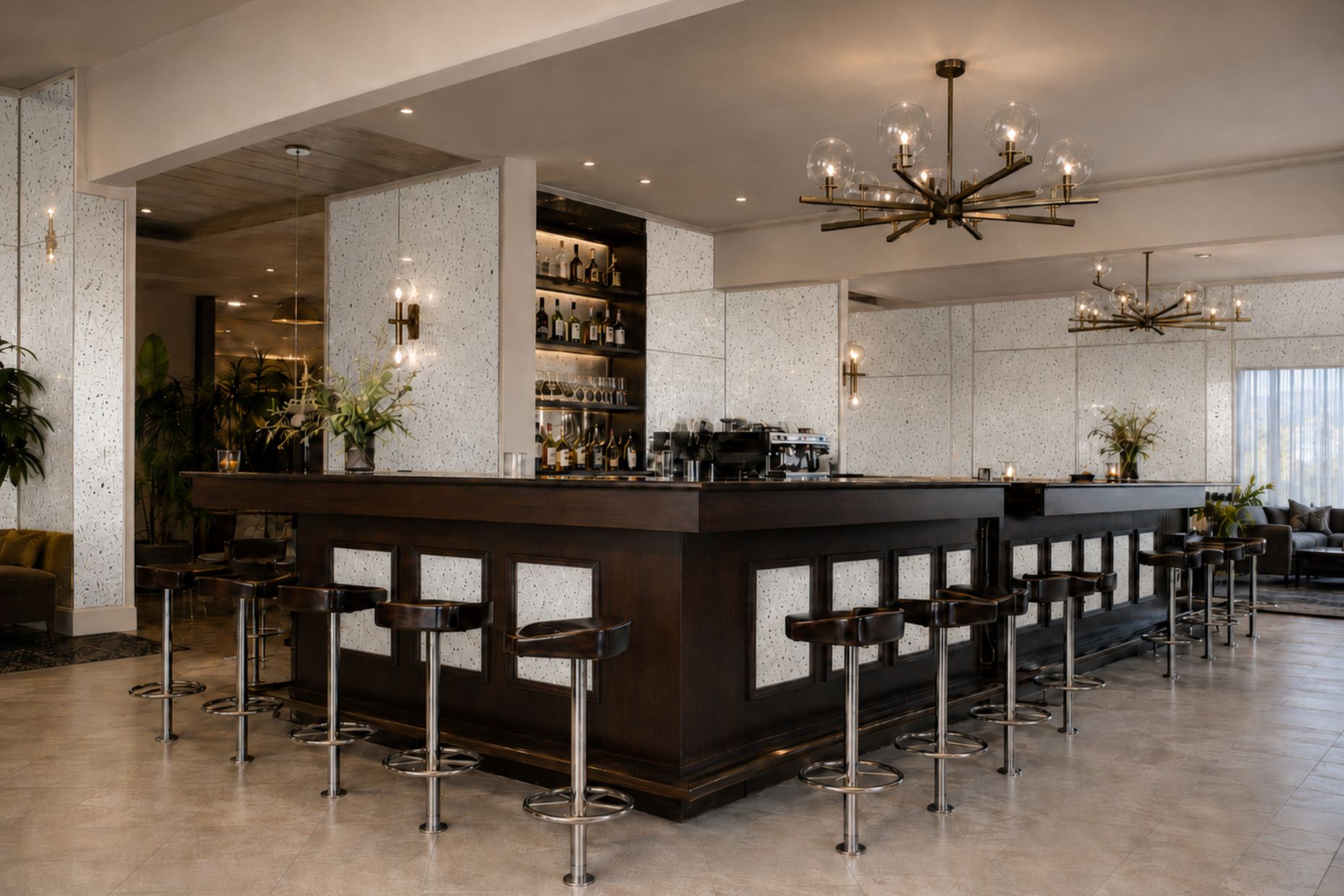
What Is Decorative Mirror Glass?
Decorative mirror glass is an architectural surfacing material that designers use to introduce reflection, color, light, depth, and visual texture into interior spaces. Depending on the desired effect, designers can choose from standard clear mirror, low-iron mirror, bronze- and gray-tinted mirror, satin-etched mirror, antique mirror, and specialty finishes such as dichroic mirror.
Because each mirror type creates a different visual effect, designers should choose the mirror based on the project’s aesthetic and functional goals. For example, a project may require:
- An accurate, functional reflection
- A brighter, more color-neutral appearance
- A warmer or darker reflective surface
- A softened, diffused reflection
- An aged, patinated or artistic effect
- A dynamic surface that changes with lighting and viewing angle
In addition, decorative mirror glass offers considerable design flexibility. Architects and interior designers can incorporate it into wall cladding, backsplashes, ceilings, columns, cabinetry, furniture, elevator interiors, dressing rooms, bathrooms, restaurants, bars, hotels and residential feature walls.
Ultimately, the appropriate mirror type depends on the desired appearance, application, lighting conditions and performance requirements of the space.
Why use mirror as an architectural surface?
Mirror changes how occupants experience a space. Large mirror panels can make a compact room feel more open, redirect light into darker areas and visually connect separate interior elements. Smaller panels, borders and inserts can provide detail without dominating the design.
The effect depends on placement. A full-height mirror wall can expand the perceived dimensions of a room, while a mirror behind shelving or a bar can create depth and emphasize displayed objects. A mirrored ceiling can draw attention upward. Mirrors integrated into cabinetry can make storage feel lighter and less visually imposing.
Reflection also introduces movement. People, lighting, and surrounding finishes become part of an evolving composition. In hospitality and retail environments, this movement can add energy. In restaurants, residences and lounges, a softened or antiqued reflection can produce a more intimate atmosphere.
Because mirror interacts with everything around it, designers should evaluate samples alongside the intended lighting, wall finishes, flooring, furnishings and metalwork.
Clear mirror: the familiar, functional choice
Clear mirror provides the familiar appearance expected in bathrooms, fitness facilities, dressing areas and other applications where functional reflection is the priority.
Standard mirror is produced on clear float glass. The glass contains a small amount of iron, which can create a subtle green cast. That color may be barely noticeable when viewing the mirror directly, but it can become more apparent along exposed edges, against white finishes, or when several layers of glass are visible.
Clear mirror is often appropriate when:
- The primary purpose is functional reflection.
- Surrounding colors are not exceptionally sensitive.
- Edges will be concealed by framing or adjacent finishes.
- Standard appearance and budget efficiency are priorities.
It remains a versatile choice for commercial and residential interiors, especially when the project does not require the enhanced color neutrality of low-iron mirror.
Low-iron mirror: greater clarity and color neutrality
Low-iron mirror is manufactured using glass with much of the iron content removed. The result is a brighter, more color-neutral reflection with substantially less of the green cast associated with standard clear glass.
This difference becomes particularly valuable when the mirror is installed next to white marble, light-colored stone, pale millwork, or other finishes where color accuracy matters. It can also improve the appearance of exposed polished or beveled edges.
Low-iron mirror is well suited for:
- Luxury hospitality and residential interiors
- Retail dressing rooms and fitting areas
- Salons, spas and cosmetic environments
- High-end bathrooms
- Jewelry and fashion displays
- Interiors with white or light-neutral finishes
- Applications where reflection and color rendering are central to the experience
Low-iron mirror is not automatically necessary for every project. If the mirror will be framed, viewed from a distance, or surrounded by darker finishes, standard clear mirror may satisfy the design intent. A side-by-side sample review is the most reliable way to determine whether the visual difference justifies the selection.
Tinted mirror: using reflection to shape mood
Tinted mirror provides reflection while introducing color. Bronze mirror creates a warm, amber-toned effect that complements wood, brass, leather, stone, and warm lighting. Gray mirror offers a cooler, more contemporary appearance and can work well with blackened steel, stainless steel, concrete and neutral palettes.
Darker products, including black and smoked-mirror effects, create visual depth with a more subdued reflection. Gold mirror can add warmth and emphasis where a metallic design language is desired.
Tinted mirror is frequently used in:
- Restaurants, bars and lounges
- Hotel guestrooms and public spaces
- Retail interiors
- Elevator cabs
- Feature walls and columns
- Cabinet and furniture inserts
- Residential dining rooms, kitchens and powder rooms
Designers should not select tinted mirror from a digital image alone. Screen settings, photography and ambient lighting can significantly alter how its color appears. Samples should be viewed vertically and, when applicable, horizontally because orientation, surroundings and lighting can change the perceived tone.
Satin-etched mirror: a softer approach to reflection
Satin-etched mirror combines reflectivity with a smooth, matte surface. Instead of producing a sharp image, it diffuses light and softens the reflection. This makes it useful when the design calls for the luminosity of the mirror without the visual activity of a fully reflective wall.
GGI’s Pearl™ satin-etched mirror collection includes low-iron, gray and bronze options. The different substrates allow designers to pair a softly reflective finish with a bright neutral, cool gray or warm bronze color direction.
Satin-etched mirror can be considered for wall cladding, furniture, cabinetry, elevator interiors, hospitality spaces and other applications where a quieter reflective surface is desired. Its uniform finish can also complement polished glass, stone, wood and metal without competing with those materials.
Antique mirror: patina, variation and visual character
Antique mirror is created to reproduce the variation and patina associated with naturally aged mirror. Depending on the pattern, it may feature cloudy areas, mottling, metallic accents, areas of reduced reflection, or expressive color.
Antique mirror is not necessarily salvaged or old. It is a contemporary decorative product made to deliver an aged or artistic appearance with greater availability and design control.
Subtle silver, pewter, and neutral patterns can add texture while remaining compatible with a wide range of interiors. More colorful designs can function as statement surfaces and architectural artwork. Because the pattern interrupts the reflection, antique mirror can introduce depth without making occupants feel surrounded by uninterrupted mirror.
It is often specified for:
- Restaurant and bar backsplashes
- Hospitality feature walls
- Residential dining rooms and powder rooms
- Fireplace surrounds
- Cabinet and door inserts
- Elevator interiors
- Ceilings
- Retail displays
- Decorative furniture
Pattern scale deserves careful attention. A sample may show only a small part of the overall design. Designers should consider how the pattern will read across the full panel size and how seams will affect its continuity. Because many antique finishes intentionally vary, exact repetition should not be expected. That variation is part of the material’s character.
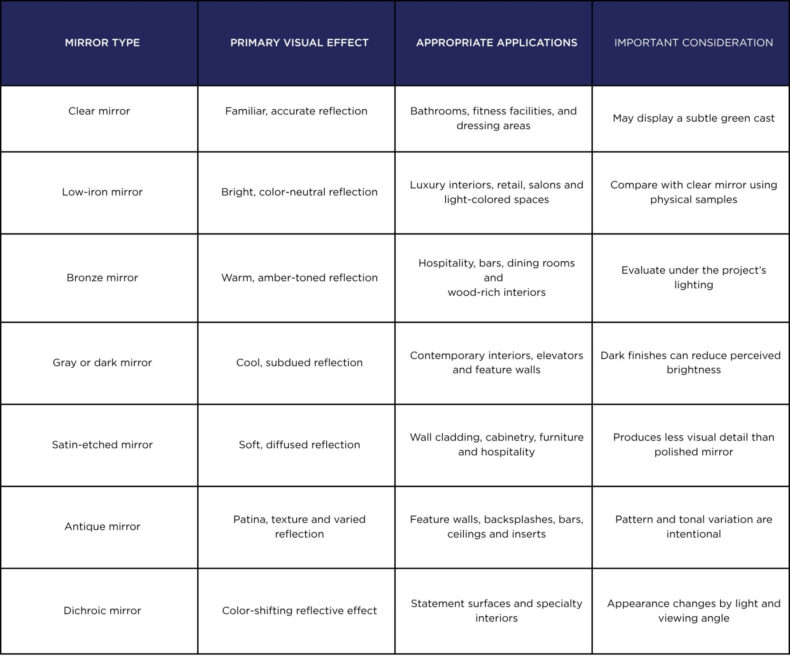
Comparing decorative mirror options
Decorative Mirror in Completed Projects
The most successful mirror installations begin with a clearly defined design objective. By first identifying the desired visual effect, designers can select a mirror that supports the character, atmosphere and overall experience of the space.
At Casa Apicii in New York, designers used Cometa antique mirror to connect contemporary details with the historic character of a 19th-century Greenwich Village townhouse. In addition, gold-toned accents within the mirror complement the restaurant’s blend of modern and traditional Italian influences.
Similarly, at Rosa Mexicano in Tribeca, Bianco E Nero antique mirror helps create an intimate atmosphere. Its patinated surface adds the depth and light associated with mirror while reinforcing the warmth of the interior. As a result, the mirror contributes visual interest without producing an overly sharp reflection.
Decorative mirror can also serve as a form of architectural expression. In the Travis London Miami residence, for example, Policromo pink antique mirror creates a luminous statement wall, while Policromo Cobalto introduces deep blue color across an adjacent hallway ceiling. Together, these reflective surfaces capture light, movement and surrounding color, making the mirror an integral part of the home’s visual narrative.
Ultimately, these projects demonstrate why designers should select mirror according to the experience they want to create. One pattern may subtly reinforce a historic setting, while another can become the defining artistic element within a space.
What should be considered when specifying architectural mirrors?
- Define the purpose of the reflection
Determine whether the mirror must provide an accurate functional reflection or primarily serve as a decorative surface. Clear and low-iron mirrors are typically better for high-clarity reflection. Tinted, satin-etched, and antique mirrors place greater emphasis on mood, color, or texture.
- Review full-size samples when possible
A small sample is useful for comparing color and finish, but it may not communicate the complete pattern or scale of an antique mirror. Review larger samples or project photography and examine the material in lighting similar to the final environment.
- Plan panel sizes and seams
The available sheet size, site access, and installation conditions can influence the final panel layout. Seams can be aligned with millwork, architectural joints, shelving or other interior elements so that they appear intentional. Large walls should be designed as compositions rather than divided only according to the maximum available sheet size.
- Coordinate fabrication early
Mirrors can be fabricated with polished edges, bevels, holes, notches and cutouts, depending on the product and application. Locations for outlets, switches, sconces, hardware and mechanical attachments should be finalized before fabrication.
GGI offers custom glass fabrication and design assistance for projects requiring specialty sizes, shapes and edgework. Product-specific limitations should be confirmed before drawings are completed.
- Address safety requirements
Conventional silvered mirror cannot simply be treated like standard heat-treated architectural glass. Depending on its location and applicable codes, a project may require an appropriate safety-backed or laminated mirror assembly.
Safety backing is designed to help retain fragments if breakage occurs. A laminated assembly may provide another option, depending on the product, application and required performance. However, the terms “safety-backed” and “laminated” should not be used interchangeably.
The architect, glass fabricator and glazing contractor should confirm the applicable code, tested assembly and installation method. The U.S. Consumer Product Safety Commission identifies 16 CFR Part 1201 as the federal safety standard for certain architectural glazing applications.
- Protect the backing and edges
The reflective coating and backing are critical components of the mirror. Edges should be fabricated, handled, and installed according to manufacturer requirements. Moisture should not be allowed to remain around the perimeter or behind the mirror, and adhesives must be compatible with the backing.
This coordination is particularly important for backsplashes, bathrooms, spas and other environments where water or high humidity may be present.
- Establish cleaning and maintenance procedures
Mirror should be cleaned with nonabrasive materials and compatible cleaning products. Liquid should not be allowed to collect along exposed edges. The National Glass Association’s guidance for handling and cleaning decorative glass recommends special care for mirror surfaces because their metal layers must be protected.
Frequently asked questions about decorative mirror glass
What is the difference between clear and low-iron mirror?
Clear mirror is manufactured using standard clear float glass, which can have a subtle green cast. Low-iron mirror uses glass with reduced iron content, creating a brighter and more color-neutral reflection. The difference is most noticeable near exposed edges and alongside white or light-colored finishes.
Is antique mirror actually old?
No. Architectural antique mirror is a contemporary decorative product manufactured to reproduce the patina, variation, and softened reflection associated with naturally aged mirror.
Can antique mirror be used as a backsplash?
Yes. Antique mirror is frequently used for kitchen, bar, and restaurant backsplashes. Fabrication details, edge protection, compatible adhesives, proximity to heat and exposure to moisture should be evaluated for the specific installation.
Can mirror be fabricated with holes and cutouts?
Many mirror products can be fabricated with polished edges, holes, notches, and cutouts for outlets, switches, sconces, and hardware. All locations and dimensions should be coordinated before fabrication, and product-specific limitations should be confirmed.
Does architectural mirror require safety backing?
Not every mirror installation has the same requirement. The need for safety backing, lamination, or another tested assembly depends on the application, location, size, and governing codes. The project team should verify requirements with the glass fabricator and glazing contractor.
How should architects select an antique mirror pattern?
Begin with the desired mood, color and degree of reflection. Then evaluate the pattern’s scale, variation, orientation and appearance under the project’s lighting. Larger samples and installed project images provide more information than a small digital swatch. Visit the National Glass Association website for educational resources on mirror.
From Product Selection to Architectural Experience
Decorative mirror delivers the greatest design impact when architects and designers treat it as an integral part of the architecture rather than as an applied accessory. Reflection, color, pattern, panel size, seams and adjacent materials all shape the final result.
Therefore, early collaboration can help the design team compare samples, confirm fabrication requirements and coordinate installation details before those requirements constrain the design. GGI offers clear, low-iron, tinted, satin-etched, antique and specialty mirror options, along with design resources and specification support for commercial and residential projects.
Ultimately, when designers select mirror with purpose, it does more than reflect a space. It influences how people see, perceive and experience that space.
About the Author

Rocco Ficara is National Sales Manager for GGI’s Specialty Glass Division, bringing more than 30 years of experience in sales and product management within the architectural and decorative glass industry. He plays a key role in expanding GGI’s specialty glass portfolio, introducing new product solutions and supporting branding and market development initiatives. Ficara works closely with architects, designers, glaziers and industry partners to help identify glass solutions that address both design intent and project performance requirements. Ficara may be contacted at rficara@generalglass.com.